
The Ukraine-Russia conflict and what President Zelensky is teaching us about the art of war in the age of social media
By Jim James, Founder EASTWEST PR and Host of The UnNoticed Entrepreneur.
In each episode of the UnNoticed Entrepreneur podcast, I try to pick up tools and tips for entrepreneurs to get noticed. But like most people, I’m finding it very hard to focus right now because the situation in Ukraine is beyond belief. And I wanted to look at the aspects of the Ukraine-Russia conflict that might still be relevant for the show.
In the recent episode of the podcast, I looked at some of the ways that Ukraine President Volodymyr Zelensky has been using social media and how this war is the first war to be held on social media. I think it’s time for all of us to reflect and look at the kind of Orwellian use of information and misinformation.
First, I looked at the use of Twitter by Zelensky and the use of infographics. Then, I looked at how public relations (PR) is where the true battlefield lies.
Of all the marketing disciplines — advertising, events, direct mails, and websites — what we’re seeing is that during wartime, PR is the number one weapon that both sides are using. In fact, it’s not just both sides — it’s all sides, including governments, non-governmental organisations (NGOs), and refugees. Everybody is in information-sharing overload.
Twitter Wars
As we learned from Donald Trump, Twitter can be a direct-to-end reader or viewer tool that bypasses traditional media.
Image from Unsplash
Zelensky has his own Twitter account, which is @ZelenskyyUa. On February 26, at 4:42 p.m., he had 2.3 million followers. By 11:22 p.m., he had 2.8 million followers. The next morning, at 10, he had 3.2 million people. Over a period of not even 24 hours, he picked up 900,000 followers. Later that day, on February 27 at 11:16 p.m., he was at 3.6 million. At 6:53 a.m. of March 1, he was at 4.1 million. By 8:00, he was at 4.3 million. On March 2, when I recorded the podcast, he was at 4.4 million.
Within a matter of days, Zelensky has picked up over 2 million followers around the world.
If we compare that to the President of Russia, which is @KremlinRussia_E, it had 1.3 million on the same date that I started tracking these Twitter accounts. On March 2, he had 1.5 million followers. He just gained 200,000 followers in the same period of time.
Zelensky has been the right man for the job when it comes to social media warfare. As we know, he was possibly ridiculed for his background as an actor. But what we’re learning in this war is that the theatre of war is the mobile phone.
Zelensky has been posting eight to nine posts a day from his account in one language. It’s about 16 bilingual posts. He’s posting about every one hour during daylight hours and he’s posting that in both English and Ukrainian.
What’s interesting as well is that we take for example his recent post about talking with Boris Johnson, he had 2,640 comments, 10,000 reposts, and 79,000 likes (at the time of the podcast’s recording). In fact, when you watch Zelensky’s Twitter, it’s like a ticker tape feed. This is how quickly the likes, retweets, and comments are going up.
On the other hand, Russian President Vladimir Putin (who, by the way, does have his own English language Twitter account) has a negligible number of followers. So I’ve taken the President of Russia account, which is only written in English, for comparison. When he posted recently about his talks with the President of Kazakhstan, he had 1,414 comments, 233 shares, and 1,600 likes. He posted four posts on March 2 and two on the day before.
The amount of content that Zelensky and his Ministry of Foreign Affairs (which also has a bilingual account, together with almost every member of the parliament — some are posting in Russian as well) shows how they’re using Twitter in a phenomenal way.
They’re also using Facebook but I’m focused on Twitter because it has hashtags and it’s how the news is being tracked. It can also be shared very easily next to the official news channels like CNN, the BBC, CGTN, and all the major international players.
Twitter is proving to be a vital part of Zelensky’s arsenal when it comes to communication.
The Use of Infographics, Video, and the Web
I also recently shared some infographics that Ukraine created to show their successes on the battlefield.
Screengrab from MFA of Ukraine Twitter
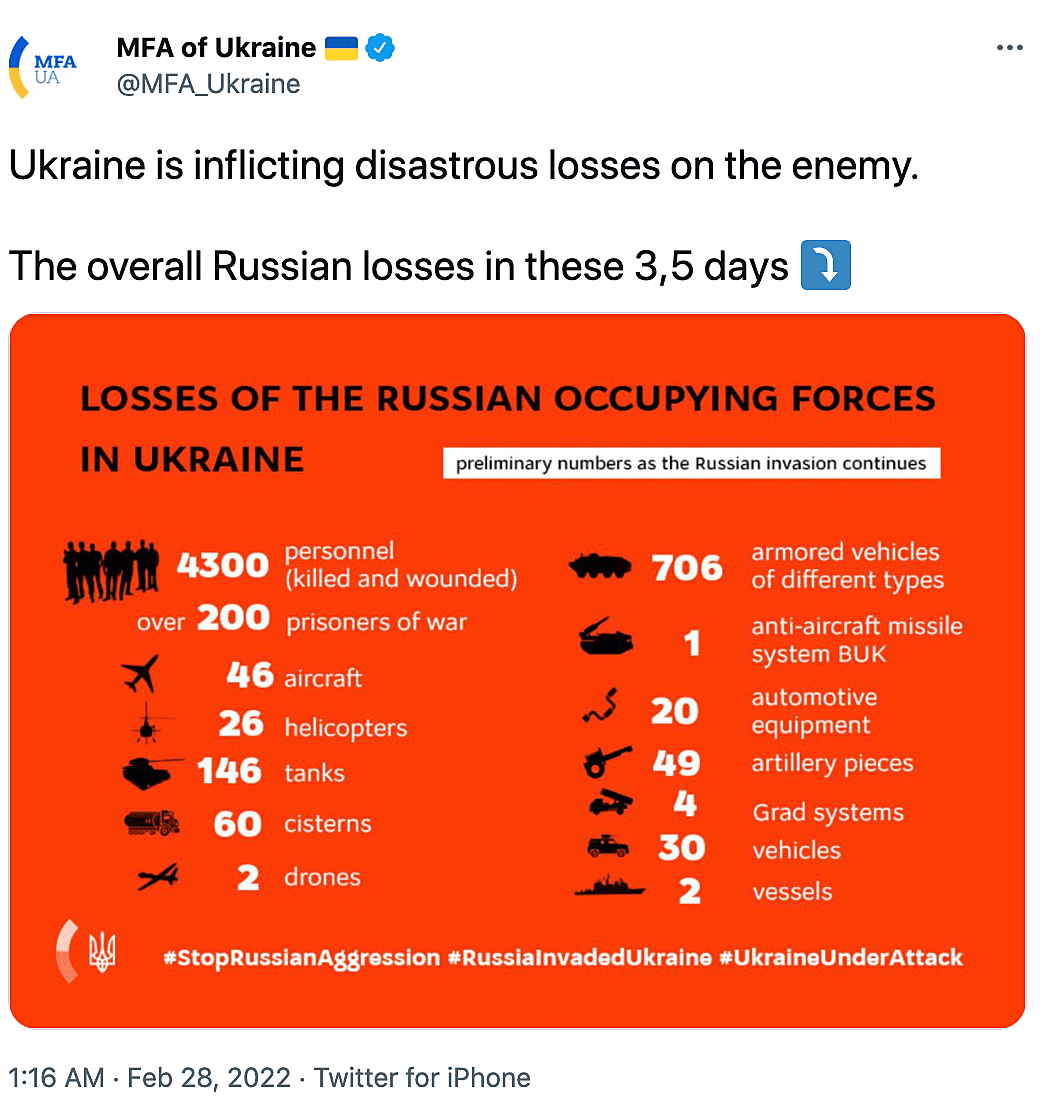
I thought that it was also very interesting to create. It’s a bright orange infographic in an Instagram size. It’s seen on Twitter but can also be used in all manner of places. The post (dated February 28) is about the losses of the Russian occupying forces, and it’s in English.
It shows some preliminary numbers as the Russian invasion continues. It has icons to show 4,300 personnel were killed, 200 were prisoners of war, there were 46 aircraft, 26 helicopters, 146 tanks, 60 cisterns (which are mobile tanks), and two drones. It also has the hashtags, #RussiaInvadedUkraine, #UkraineUnderAttack, and #StopRussianAggression. They also did the same infographic on the same day but in Russian. It shows how they’re using social media very cleverly.
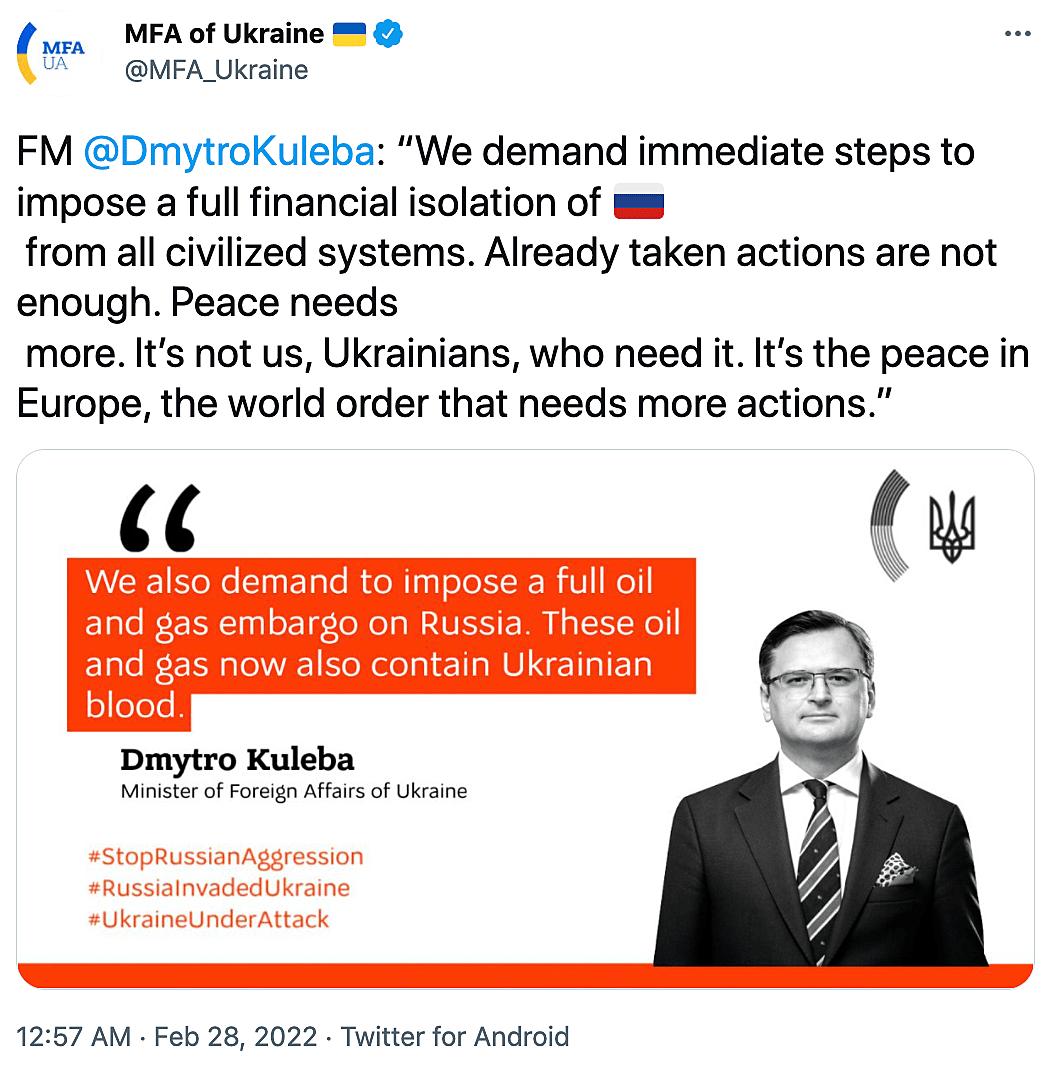
They also did a very delicately done infographic of Dmytro Kuleba, the Minister of Foreign Affairs of Ukraine, where it says that they “also demand to impose a full oil and gas embargo on Russia. These oil and gas now also contain Ukrainian blood.”
The infographic also has a picture of him in black and white laid out to the right; there’s an orange background for the text with a white background for the whole picture. They also used the same hashtags.
Screengrab from MFA of Ukraine Twitter
Interestingly, they haven’t used the Ukrainian colours of blue and yellow. But what we’re really seeing is a concerted effort by the Ukranians to use social media.
There was one young woman interviewed on the BBC and she was asked about why she hadn’t left. She said that she could’ve done that but when she looked at the Internet and looked at what the government needed, they needed people to manage the information wars. So she and her friends decided to stay and to communicate with the outside world by creating infographics, tweets, blog posts, and videos. As we’ve seen from Zelensky, he famously walked down the street, filming himself in front of the parliament building in Kiev.
As a generation in their 40s, as leaders who are younger, they’re using social media in a phenomenally powerful way.
Of course, all of this isn’t necessarily winning the war for them. But it is winning the conscience war. And one of the things that I saw that they did which was very clever is that they launched a website. On that website, they have a phone number for captured Russian soldiers to be contacted by their families in Russia. They put phone numbers for the Russians to call in order to find out if the Russian soldiers have been captured or killed in Ukraine.
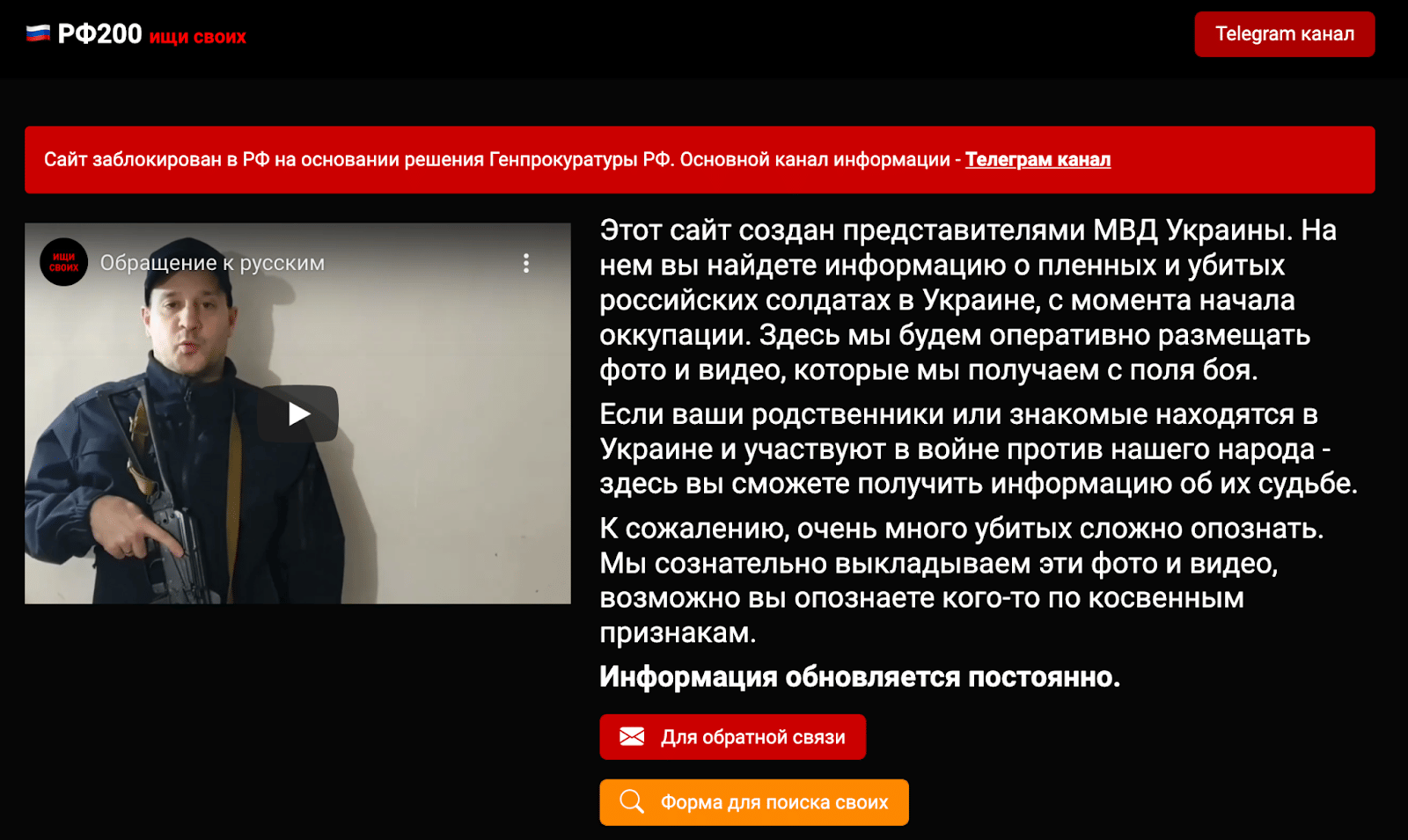
Screengrab from 200rf.com
Monitoring the War on Russian TV
They are all using different devices very cleverly. This is obviously helping them in some respects. But when we look at what’s happening in Russia — there was an interesting post by the BBC talking about monitoring the war on Russian television.
The article was by Simona Kralova and Sandro Vetsko and was published on March 2. It’s about how the people in Russia are getting a different kind of news. This is the heart of George Orwell’s “1984” book: Doublespeak. It’s where we have the juxtaposition of one noun next to one another to make it sound sensible.
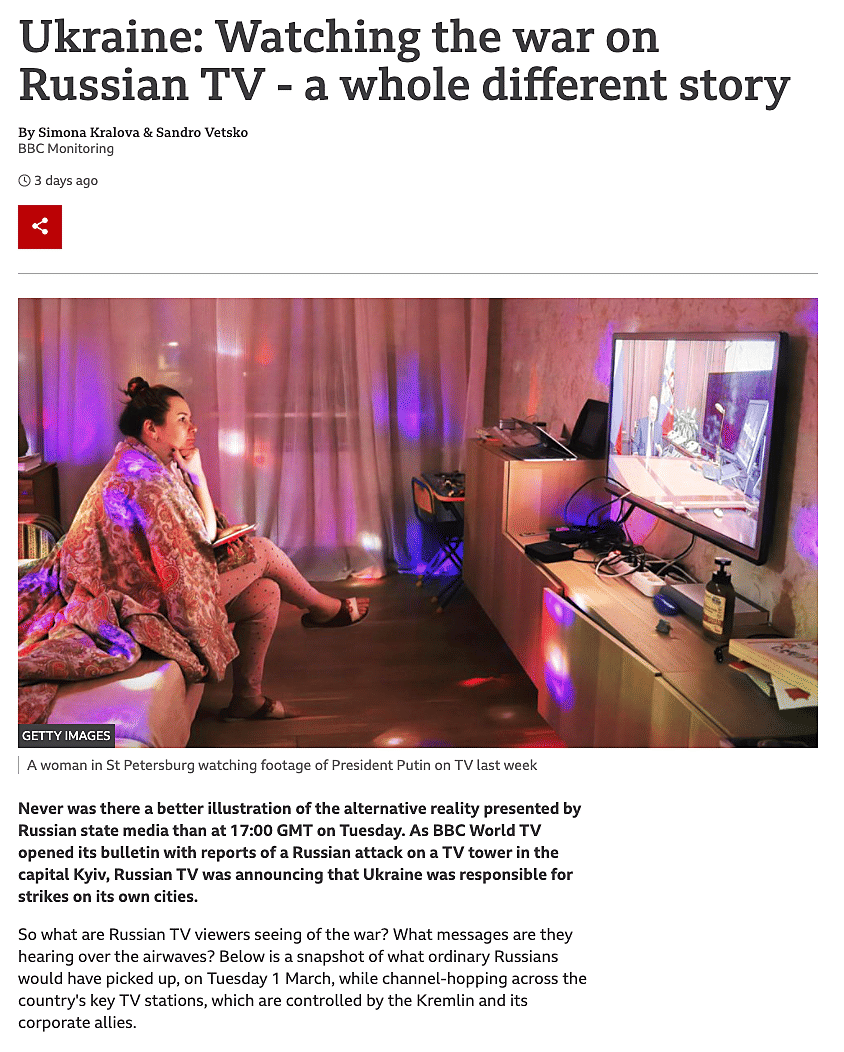
Screengrab from the BBC
There couldn’t be many better illustrations of this than the idea being espoused on here. For example, the article quoted a Russian TV presenter, saying: “Footage continues to be circulated on the internet which cannot be described as anything but fake.” They described it as “unsophisticated virtual manipulations.”
They were also showing a tank, which appears on social media to be a Russian tank in the Ukrainian conflict. They’re saying that it has been doctored and it’s actually from Donbas in 2014.
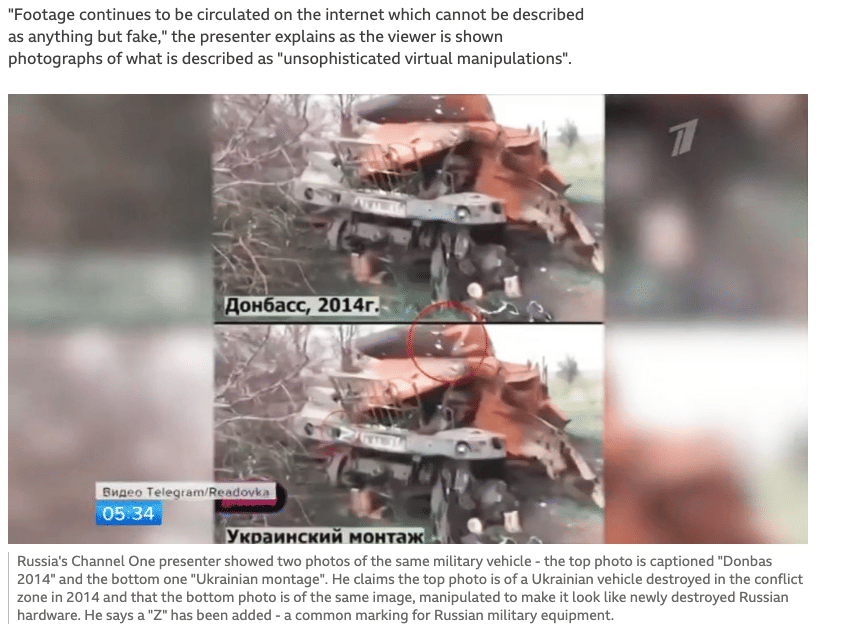
Screengrab from the BBC
They also have another idea (which is scarily fanciful but for many people, this is their truth). According to the BBC article, the Russian television is saying that the Ukrainian nationalists are using “civilians as a human shield, deliberately positioning strike systems in residential areas and stepping up the shelling of cities in Donbas.” They’re accusing the Ukrainians of bombing civilians in the Donbas region in the East.
They’re also saying that “the tactics of nationalists who use children to shield themselves have not changed since the Second World War.” This was reported by a presenter on Rossiya 24, a Russian TV channel.
They continued by saying that “they behave like fascists, in the very sense of this word: neo-Nazis put their hardware not just next to residential houses but where children take shelter in basements.”
In Russia, it carries on like this across all of these mediums across the day.
Perhaps, the most worrying was a bulletin by Rossiya 1 about striking Kharkiv. It asked: “To strike Kharkiv and say that it was Russia. Ukraine is hitting its own and is lying to the West. But is it possible to deceive the people?”
It also said that the “main objective” in Ukraine, as far as Russia is concerned, is “the defence of Russia against the threat from the West, which is using the Ukrainian people in its stand-off with Moscow."
The BBC article further wrote: “To counter what is described as ‘fake news and rumours’ about Ukraine which are circulating online, [the presenter] announces that the Russian government is launching a new website where ‘only true information will be published.’”
What We Can Do
In PR, we’re getting fed the news that we want to be fed. And it’s more of the news that we’ve already seen. Twitter is the same. All of these social media channels send us something comparable to what we’re already watching. When we’re doing our PR in wartime, we can see the polarisation and the disinformation that’s taking place.
We’re also all familiar now with the bots. But what we’re seeing is that disinformation is driving people apart.
What role can we all play? Plainly, we have to fact-check what we are sending.
There’s another thing that we can do if we’re interested in showing solidarity with the people of Ukraine. I personally have put a Ukraine flag on my LinkedIn account. I also have “I stand by Ukraine” as my banner for my Twitter page.
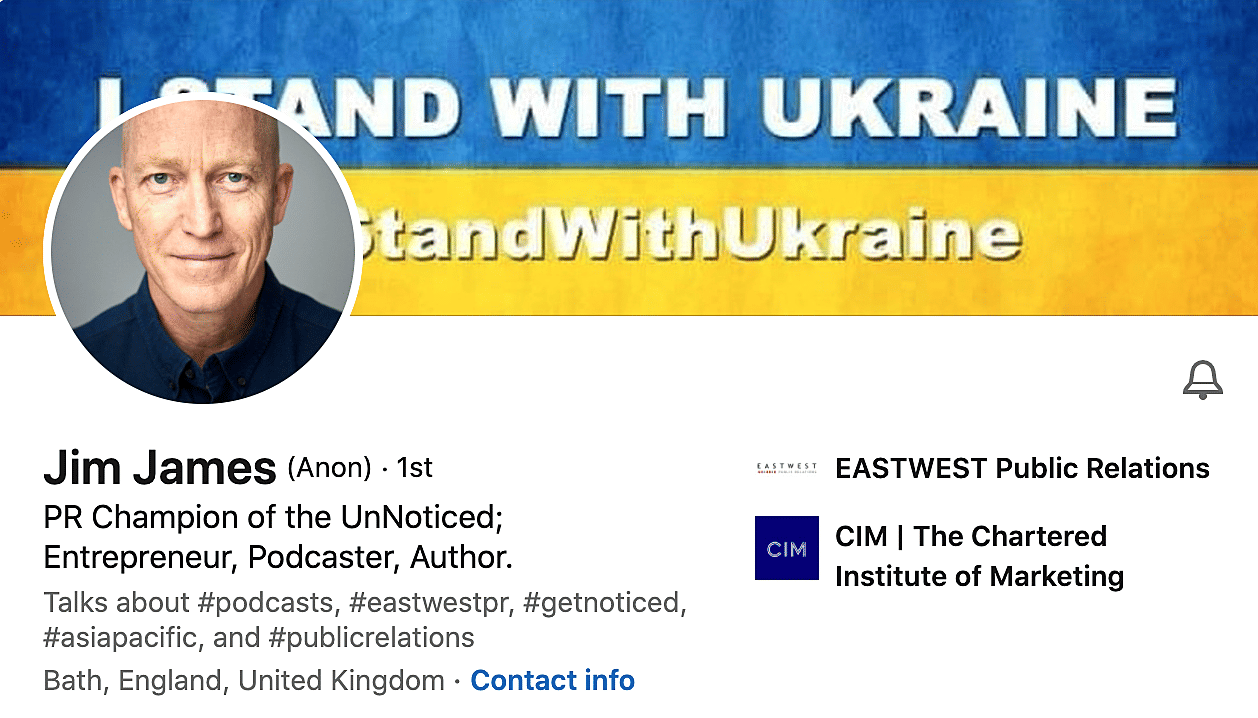
Screengrab from LinkedIn
We can do these small ways. We can also help amplify those posts that we know to be true; share those within our own networks to get more people on board with what’s actually happening. There can’t be many people now who don’t know what’s happening.
Part of what I’m trying to do is to also share what the Russians are also seeing. Because it’s only by understanding what they’re seeing that we will understand their motivation and their potential behaviour in and around the actions of the Western forces and the Western media.
Wrapping Up
As you plan your own PR for your business, one of the lessons of this Ukraine-Russia crisis is the use of social media — taking the war to the home and into your hand. Everybody is an actor. No one now can be left out.
Another lesson is that what we see as the truth isn’t what other people see as the truth. Your own team may 100% believe in what you’re doing, but your customers and partners may not. Let’s pray that the understanding or misunderstanding that you have with your audience doesn’t lead to this kind of conflict that the world is experiencing.
I’m personally finding staying motivated through this war a challenge in terms of talking about it day-to-day. I’m asking myself, “How can I help?” And, perhaps, it is with this podcast — by highlighting a few places where you find out more about the war as well as the need to fact-check and to hear what other people are thinking about the war so that we don’t fall into the same myopic view as the Russians; so that we keep an open mind, open heart, and open arms for all those people who are fleeing the conflict.
This article is based on a transcript from my podcast The UnNoticed Entrepreneur, you can listen here.
Cover image by Craig Adderley on Pexels