
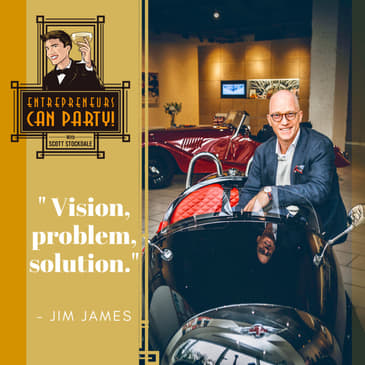
Here I am with Scott Stockdale of Entrepreneurs can party. This is part 1 of 2 episodes because the original show is 40 minutes and I keep all my shows below 20 minutes. This is the second episode follows:
Solopreneur and things that can kill a business
Working with global clients
Jim’s 5-step methodology
The “one” tip to kickstart your PR agency
Avoiding overtrading and a cash solution if you do.
We only accomplish in proportion to what we attempt.
Be sure to follow Scott on Instagram @entrepreneurscanparty
SPEAK|Pr is for business owners to unlock the value in their organization for free with effective communication and is hosted by international Pr agency owner and entrepreneur Jim James.
Read the article version of this episode - https://theunnoticed.cc/episode/25-years-of-running-businesses-in-asiamy-business-stories-with-scott-stockdale-part-2
If you like this podcast, then subscribe to our newsletter here
Please visit our blog post on PR for business please visit our site:
https://www.eastwestpr.com/blogs/
If you want to know how to get noticed this show is for you. I have interviews, tools, tips, everything that an entrepreneur could need in order to help their organization to get noticed for free. Thank you for joining me on the unnoticed show.
Buzzsprout - Let's get your podcast launched!
Start for FREE
Please rate the show here.
Thank you for listening to this episode of the unnoticed to show. I hope that you've enjoyed. If you have, please do rate it on any of the players. If you'd like more information, go over to EASTWEST PR and subscribe to our weekly newsletter. Or connect with me on Linkedin that's just Jim James. I'd be delighted to connect with you and let me know how i can help you to get noticed.
Support the show (https://lovethepodcast.com/Unnoticed)
The UnNoticed Entrepreneur is hosted & produced by Jim James.
So in this the second part of the interview with Scott Stockdale of the entrepreneurs can party a share about moving to Singapore. 1995 is a 27 year old, starting Easter's public relations, managing cash flow, managing clients, and how I learned Mandarin, using the radio. So tune in for this one, it's just another 20 minutes. And I hope that you find it interesting, a little bit of slice of life. And hopefully, maybe one or two tips and pointers that would be a value to you if you're running a company. And what what made you want to go back? Was it just the experience you have when you're on the business trip? So basically, in in 94, I went to a trade show in Singapore, and was just struck by the dynamism of Southeast Asia really. And so it was a result of going to Singapore, I found that no one was doing technology, public relations in Asia. And and so I thought, Well, why don't I do that? Why don't I just set up a company doing it? sold the house in Manchester. And, and the suitcases are set up in Singapore? So many questions in that. So I guess the first thing, you can come back to them however you like, I'm just going to throw these questions at you. So what? Or were there any doubts when you decided to take that leap? So that's kind of the first question. I guess the second question to follow that is, were you planning on being kind of quote unquote, solopreneur? or doing it on your own? Or did you always plan to kind of grow a team? and tackle these challenges together? The answer is that for the, for the sort of doubt, you know, a lot of people said, well, you don't know anyone in Singapore, you never lived in Singapore, you've never run an agency club work for I had only worked for companies before, I'd never been an entrepreneur before. You know, frankly, if you think of all the reasons that you can fail, you've got the ball. But I think what I what I felt at the time was that I could always go back, you know, and I knew when I left Manchester already, but had bought a house at the age of 23. In those days, you could afford to do that, because housing was so inexpensive, my first house cost me 60,000 pounds. So you know, to give you an idea of the difference in cost. So I left I left England feeling that Singapore is full of opportunity and worst case, worst case, I would be able to come back to England and have taken a couple of years out lived in Asia. But having said that, I did sell everything and took the proceeds to Singapore to start the business. Because I really didn't think of failing. Because I think that leaves a shadow of doubt in your mind. What I did do, and I think it's worth mentioning is you know, whose it talks about Alexander the Great was about Burn, burn the boats, you know, and actually, I didn't burn the boats, because I think that's a little that's a little bit creates a level of risk you don't need. So I left some capital in the UK. So I left some money in the UK from selling the house, on the grounds that if you take all of your money with you, actually what happens if you've got it there in your bank account, you spend it. And and it's very easy when you're running a company to spend all the money quite quickly. So I left myself with a very tight budget. When I got to Singapore, so I live with two other guys. One from Scotland and one from from South Africa, worked out of a tiny office. So I kept the budget really, really small. So if no one's going to do this and go somewhere else, and so really, really recommend leaving 10 to 20% of your assets back at base. So that if things don't go quite as planned, you can either call on Chris going well enough, you need some extra funds, or you've got a parachute. To get out there really isn't any risk. Any reason to take 100% risk, not necessarily in terms of solopreneur I've never run an agency. I work for an agency in my first job outside of university and it went bankrupt after six months of me joining Not, not like join Yeah. Which I don't think so. But in 1990, you'll be you know, maybe some of your listeners will will remember this, but there were pretty bad economic times in the UK, where this is the feared of form 3 million unemployed and sort of factors, you know, post miners strike and so I hadn't got the ambition to hire people. I just really, I'd really got the ambition to get to Singapore and start, but I really wasn't mature enough to think about the shape of the business or frankly, even whether I'd find business. What I really figured was if I get there with some funds, and some ambition, and what I'd done though, in advance was I had been out there on a business trip in January of 95 and found an office. So there was a there was a publisher I knew. So I wrote to a say, Can I borrow rent 50 square feet from you. So there's about 200 Singapore dollars, 100 pounds a month at today's rate. And it gave me a postal address and Tilak is street 1818 telecom Street. And with that address, I then wrote to everybody I knew from Siemens and Harman all these companies, I wrote to them saying, I'm going to Asia to start a PR business, if you need help. This is my address. This is my company address. So I did that three months before I went, in those days, you had to send letters, right? So in those days, it take a week to 10 days for them to get a letter to read it, write something and send one back, right, so you need to leave have about a monthly to. So when I arrived in Singapore, and about 25 letters from people saying congratulations, and, and including a couple of companies that have bought Ms. Neve equipment, said we've got all this equipment, now we need to do the marketing for our studios. So within a couple of months, I had clients in Hong Kong, Bangkok, and Kuala Lumpur. And that that was unexpected, to be honest. But um, so I didn't have ambition, I didn't know what the company would look like. But I did start to try and identify who would be my customers in advance. Mm hmm. But there's so many great things in what you've just been saying. I want to kind of underscore, I think the the first thing about leaving some capital at home, when you're looking to start a business abroad, very smart. And I think the other things you've been talking about actually having, I guess, equivalent of some leads going out there. So you know, having these letters, which you can then you know, potentially build some business once you're older, very, very smart as well. People often start the business, and they completely underestimate how long it's going to take for business to come in. It's no one's fault, but you have issues of you, when you write to people, they may not be ready for your service, right? The assumption that when you tell people, they go, Oh, that's just what I need right now. And I'll pay you right now. Because you meet all all my criteria. But when they read your letter or email, whatever, they're going well, you've only been in business for a week. And I don't need what, but I might build that into my budget for six months time. Right. But what you do have a costs from day one, you have an office, you have broadband, you have tax, you have whatever, right. So anything you can do, to bring forward the sales pipeline, in advance of acquiring costs, to better razor, if you're going to start a business, and you're working for someone else, obviously without, you know, leveraging and take advantage of where you're working now. But on the weekends or at night, for example, it stopped working three to six months in advance on the business development side. Because then when you do leave the company or going I'm in business now, you're ideally leaving when your first client, if that could be you, you give months notice when you've got the first client, it's not in the NBA books. I've never seen that in the NBA books, to be honest. But any entrepreneur will tell it takes longer to get sales than than you're expecting. But the cost of you can drag your schedule forward. And just kind of deal with the anticipation of getting started until you've got potential leads. What it does, Scott is it saves you your capital, you know, you start a business and a p&l, but it's cash flow is the big killer when you stop. So, so when I started the business in Singapore, after 30 days, I had $25,000 worth of Billings, fantastic, great. But I also had $18,000 of costs. Now, the thing is because when you're new, no one gives you credit. And when you you know client will pay you in advance. Yeah, actually what I've got is I've paid out $18,000 to get printing and production done to print houses in Singapore, right? classes. I love your design. Can you go Okay, so but the printer says to me, it's great, but you need to pay me in advance because I've never met you. You just started right? You have no credibility. Yeah, actually, at the end of three, at the end of a month, I had $30 in my bank accounts to add on over at a net profit of $7,000, which is more by the way than I'd ever earned working for someone else in the UK, in in that length of time. But I was nearly out of business because I over traded. So I mentioned earlier on about leaving a little bit of capital in advance back home, right so I was able to call on some of that. But also what I then did was I went to all of my suppliers that are I'd paid pre paid. And I said, Look, I've pre paid you because I want to show good faith. So I want to pay you in advance, I don't want you to think that I'm just going to come in and run. So then what I did was I took my contracts with my clients, and showed them, in effect, that I had the money coming in. Because you know what they do? They say, Jim, that's great, you owe me the last 10%. But I won't release the goods until you pay the last amount. But the client won't pay the money until they've seen the goods is a constant battle, isn't it? My solution was I went and I showed them the letter of my invoice to my client. So again, these are things that are not in the MBA, whether things could kill a business, I had some good friends who started a business in Malaysia. And they got to a very big client, a very big telecommunications company in KL contracts into all their marketing, marketing literature. And six months later, they're out of business, because the Malaysians didn't pay them in time. And the printers, printers refused to deliver the product until the money was in front of them, and the Malaysians wouldn't pay them without seeing the product game over their businesses, including their life savings, because they tried to pay for the print, they could never get enough. So these are small tactics, which can save your life if you're running a business, and I just kind of learned them. I kind of learned them the hard way. And so it's like, I'm delighted I can share with some of you know, with your listeners, maybe for someone that will help them. Yeah, 100% even if it helps just one person for Donilon nice. Hundred percent, with the with the services that you were delivering at that time. Were they for Asian publications, or were they for companies in Asia wanting to get into like British publications or was it a mixture of the two? So I had had foreign companies getting into Asian media. And then I had some foreign companies like Loxley, public companies, that Thai telephone company that had seen the work I was doing for one of their subsidiaries, which is being run by a foreigner in Bangkok. And so they said, you know, Ah, here we allow you to help us. Very sweet eyes. So I had this mix, really Scott of, of some Westerners coming into Asia, had one clinical Quantel that I worked with for 12 years. And basically, they had a UK office in Hong Kong office and I ran their regional public relations. And I also worked for denarian, which launched what is now what was called for became Astro, which is the largest telecommunication satellite broadcaster by owned by Nanda Krishnan out of Malaysia. So I did all their recruitment, to the branding, brochures, so it kind of grew, really, it's great fun. Um, it sounds and I could ask you a billion more questions, but I'm very conscious of our time. So I want to kind of move on to some of the other things that I said we get into. So in terms of PR, and I'm thinking kind of specifics in terms of people listening, what sort of things they could be doing for their own PR. Now, I believe you've got a five step methodology, is that right? my love and my passion is, you know, to help entrepreneurs, fellow fellow business owners. So I've, I've developed a programme called speak PR, which is for Storify, personalise, engage, amplify and to know, and they can find that each recipe on.com. It's also on our podcast, as you know, on speak PR podcast, and also on our YouTube. Basically, this is a five stage methodology that business owners can use to unlock the value in their own businesses without needing an agency. And it starts with storage allocation, which is all about how to build a narrative around them around themselves and on their business. How to personalise that for three different audience groups, which are the internal, the partners, and the external or otherwise customers engagement, which is around creating, creating engaging content, and how you can do that through infographics, text, video, and so on. The third is amplification, and an amplification. A big part of that narrative is about automation. And so I explain about how one can deliver information across multiple channels without a big team using automation tools. And then the third part is what we call No. And what I've done is I've developed what I call the active communications index. And this is a productivity metric. So what happens is that many companies are concerned about or many marketing as a description. Sort of concerned about how many page views, how many clicks, how many engagements. But the problem is we can't control that. Because it's that really is up to whatever people think about our content. What we can control as business owners is what goes into the activity. So I've created this active communications index, because I'd like for business owners to better say to whoever it is doing their public relations, how many press three week? What's the frequency of that? And what's the channel that we're sending out how many channels so the ACI, as I call it is a function of content, frequency and channels? Well, that would be great for listeners to find out more about, yes, I will provide a link to that in the show notes, you're most welcome. And for people looking to maybe get into PR would be like warm. And this is very, it's a very kind of blonde question for a very all encompassing, holistic thing. But if there was one tip you could give to someone looking to maybe get started in PR, you know, let's just picture seeing where someone's got a business haven't marketed it, really, they don't know how to get into a publication or they're wanting to get some more exposure for their brands, but they don't know how to do that. Would there be one? Yeah, one tip, I guess if you had to pick off all of them that you'd be able to give people. I think if anyone's looking to get more exposure for their PR, they The best thing they can do is think about their story. What? What makes their own company their own brand unique? Because really, one has to start, they're a bit like my jumping out of the plane. He said, that's a good hook. Right? Yeah. Oh, it's so competitive out there for pretty much everything. That what people are buying, and especially if you're buying from an entrepreneur is you're buying their reason for doing what they're doing. If you can, there are tools, there's a chap called Park cow, for example, who has a brand new witchery a book, we just interviewed him and his podcasts are out on the on my speak PR. There are quite a few. But it basically it starts with this idea of a vision, a problem and a solution. Okay, I want to do this. But there was this problem, therefore I started this business. So for any entrepreneur, or business owner, start with your story. Because if you get that, right, that exposure will follow because a bit like me saying, I'm jumping out of a plane because I want to go to Australia, but I can't afford to. Therefore, I'm raising the money by challenging myself. The media were interested in that as a as a story. If you just ring the media and say, I've got a problem, which is I need to raise money. Can you cover me it's not a very interesting story that lots of people have got to the best piece of advice is to dig deep. Often for most entrepreneurs. It's the burning passion, like you've got with entrepreneurs can party. Why are you doing this? Or what is your passion? Because it'll be the passion as we've seen, whether it's Steve Jobs, Elon Musk, any of these great entrepreneurs and social leaders, Mandela or any any great social leader, it's because they've had a cause. And if you get the cause, right and can articulate that, then the rest will follow. You need to distil do work. By the way, it's not that I'm here. To remind your own going, I've got a great story. You have to do that. But if you don't do that work upstream, you'll find you won't get the coverage later. Great tip. I like it a lot. And that is pretty much your up, Jim. So thank you so much for taking the time to party. And apologies for doing it in slightly unconventional surroundings from a Somerset field. Luckily, the rain has stopped. You might have heard. No, not at all. It's been a delight. I've got one final question for you. Before we jump off on a question, I'd like to ask all my guests. So I'll pick to the scene. Imagine we're driving down an American highway and we see a big billboard to the side. Kind of relevant for PR, I guess. You could write anything on that billboards, whether it's a story, piece of advice, equip whatever you want it to be. What do you think you'd write on that billboard for thousands of people to see? And if so, why? I think what I would write on there is I'd say life is for living, live yours. And the reason I say that is because there are lots of people that are living their lives, and we'll give advice as to how you can live yours. But you you really only have one life to lead and as long as you do it with integrity and honesty and care. I'm personally a believer that we only grow through what we attempt. And if you don't attempt anything, then it's impossible to grow. very empowering like most boys on the show. So thank you so much for taking the time to party today speak pr.com we will put that in the show notes. And if there's any other social profiles and you have a places you'd like to direct listeners towards, what would they be? And so that ended the interview with Scott Stockdale of the entrepreneurs can party so thank you to Scott for his interest in his patience and his amazing editing because I know I rambled on rather a lot. I hope that there have been some points of interest for you too. They're a little bit of something different to the normal fare. But what is going to be consistent is that I wish you the best of health, a profitable business, and that life gives you the kind of rewards and adventure that I've been blessed to have enjoyed. Thank you for listening to this episode of speak PL