
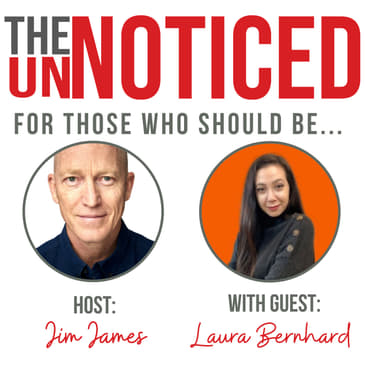

If like me, you've been vexed by the problem that you have been creating lots of content and not been getting more leads, Laura can give you some advice. Laura L. Bernhard, creator and host of The Marketing Bound Podcast that helps service-based entrepreneurs with inbound marketing. From sunny Toronto she shares her considerable insight on using blogs, social media, email nurturing, and content creation to help entrepreneurs like us attract leads and get clients.
To help grow your business, join the Marketing Bound Facebook group, and visit marketingbound.com to check out the free resources.
Read the article version of this episode - https://theunnoticed.cc/episode/my-sales-funnel-is-looking-hollow-so-i-took-this-advice-from-laura-l-bernhard-inbound-marketing-expert
If you want to know how to get noticed this show is for you. I have interviews, tools, tips, everything that an entrepreneur could need in order to help their organization to get noticed for free. Thank you for joining me on the unnoticed show.
Buzzsprout - Let's get your podcast launched!
Start for FREE
Please rate the show here.
Thank you for listening to this episode of the unnoticed to show. I hope that you've enjoyed. If you have, please do rate it on any of the players. If you'd like more information, go over to EASTWEST PR and subscribe to our weekly newsletter. Or connect with me on Linkedin that's just Jim James. I'd be delighted to connect with you and let me know how i can help you to get noticed.
How to #getnoticed mastermind.
#getnoticed with courses and masterminds developed by experienced PR agency owner Jim James.
Email Signatures Full of Brand Promise
Create Branded Email Signatures for All Employees in Few Minutes.
Support the show (https://lovethepodcast.com/Unnoticed)
The UnNoticed Entrepreneur is hosted & produced by Jim James.
Hello, and welcome to Laura Barnard who's joining us all the way from Toronto to talk about inbound marketing on this episode of speak PR. Laura, welcome.
Laura Barnard:Hi, Jen, thank you so much for having me today.
Jim James:Laura, you have a podcast called the marketing bound, and you're an expert at inbound marketing? What is inbound marketing? And how can it help a business owner entrepreneur to get noticed?
Laura Barnard:Mm hmm. Very, very good question. Inbound Marketing is a strategy to get your audience to come to you. So if you if you google inbound marketing, you'll get a bunch of definitions. But in summary, it's, it's when you put content out there, when you're building trust with your audience, you're putting it out for free. And when people are searching for a problem that they're having on a daily basis, and they stumble upon your content, your content is not disrupting their day, it's helping their day. So it's a non destructive, helpful piece of content.
Jim James:Now you say that it's getting to be content that they want to receive and help him with the day. How do you define that? In our spiel, we talk about content being new and simple and context sensitive. What's your definition for content that people want to receive? Because people are so busy? Do they really want anything else.
Laura Barnard:So when you type in, for example, how to start a podcast into Google, you can stumble upon, you can stumble upon blogs that are three, four years old. That's the perfect example of an inbound marketing blog, because it's still helpful. And it's still popping up. Because it's still useful. So what we call those kinds of pieces evergreen content, because it keeps lasting and it keeps helping your audience.
Jim James:So you've got evergreen, and you've got some things that are time sensitive, I guess, how does the small business owner create this content because most people that I talk to don't have the time, or they're just struggling with kind of the creativity part. So any any advice?
Laura Barnard:A lot of people think that inbound marketing is very, very time consuming. And I would have to agree, it's a long term strategy that you have to constantly put effort into. However, the long term benefits outweigh all the time that you put into it. And experts are actually saying that it's more cost effective to be working on an inbound strategy than let's say Facebook ads, or a billboard or commercial, you know, things like that.
Jim James:So why would inbound be more powerful, or better value than, say Facebook ads, because obviously, that's where a lot of people talk about Facebook marketing, LinkedIn marketing, Instagram marketing,
Laura Barnard:they could be considered inbound marketing, because they're also non destructive. When you speak about inbound marketing, in terms of blogs, email, nurturing social media, those have a longer life than a Facebook ad. Okay, so let's say you promote a new magazine, the magazine will eventually be thrown away, it won't be looked at anymore, people are going to flip through the magazine, see your ad. And that's it. However, a blog, for example, that stays on your website that stays on the internet forever. And if you have a good piece of evergreen content that will keep popping up on Google and will keep working for you.
Jim James:I see. So really, then inbound is as much about sort of giving first, isn't it? Rather than shouting to say I'm over here? And are there any sort of formats that are particularly good as inbound marketing content? You mentioned? For example, no blog posts, you've got a podcast, I've got a podcast, there's video on YouTube, any of these better or worse than the other ones? Would you recommend?
Laura Barnard:Not that they're best or worse, it's what's best for your audience. So if your audience is listening to podcasts, then that's where you want to be. If your podcast is watching video, then that's what you want to create. There's no better or worse, we just have the luxury of having many options. And then we get to pick Okay, which one are we good at? which one can we put time into? That's going to reach your audience at the right time.
Jim James:So Lori, you mentioned time, how often do you think people should be posting content then? Is there a formula
Laura Barnard:there's no magic formula as to what's best it is what depends on your audience. But I would say on a weekly basis, you should be putting out content and I'm specifying putting out content and not creating content because I believe a strong strategy g astrong inbound strategy requires batching your content. So you're create, let's say you're writing blogs, you spend one day writing for blogs, and then you slowly leak them out throughout the month.
Jim James:Now your average business owner entrepreneur may not feel comfortable with the writing, for example. And if they brief a freelance writer, one of the criticisms is that it takes as long debrief somebody as it does to do it themselves. And then they don't feel comfortable doing it. So they get to the cycle. How do you help someone to break through that sort of content block?
Laura Barnard:That's a great question. I think you have to start with what your audience is asking you. So for me, for example, and people ask me about inbound marketing. People always go to how do i do inbound marketing? So right there, that can be an idea for a blog? What is inbound marketing? And how does it help them? Boom, one blog, then you can continue? What else is your audience asking you? Right? You have to keep addressing people's questions. So then when they are typing it into Google, you're popping up.
Jim James:Okay, so that's a really, then it almost becomes just listening to your maybe your staff, your partners into your customers. And I read that one person also goes on to, for example, the Amazon book reviews, and sees what questions are still coming out? having read a book, so, but what about them from a practical point of view? If someone's not comfortable at the writing, but they know what the content should be? What should they do to get that article written?
Laura Barnard:Well, then I would actually argue that maybe they shouldn't be writing articles, maybe they should be doing podcasting, like this. Because then when you do the podcast, even if you never put this podcast out, you still have this information, you can turn it into a blog, you can turn it into an audiogram, you can convert it into a lot of other kinds of media, which is still helpful to you, and it's still considered inbound.
Jim James:And how would someone take for example, maybe they've recorded a podcast or maybe just done a voice memo on their phone? What what tools would you recommend, from a practical point of view as a workflow for them to do that?
Laura Barnard:I love that you mentioned workflow, because when you're when you have one pillar piece of content, you always have to think, Okay, how am I going to turn this into different pieces of content? And what is my process for that? So for me, when I have a podcast, I use otter AI to transcribe the podcast, I put that up. Then I also use headliner. Not sure if you've ever used headliner, but headliner, you can create the audio grams, and then I have a video component to my podcast. So I also put little videos and I put captions under them. So those are the main ways that I repurpose my podcast. And those are the tools that I use.
Jim James:Right, right, I use one called repurpose.io. Let's assume you've got all this content, Laura, going out there. And I find myself I produce a podcast and have a newsletter. And I'm getting a lot of page views on the website. But what I'm not getting is inquiries. So what am I doing wrong?
Laura Barnard:At every point in the visitors journey, you can identify out what is actually going wrong. So you're getting people to the website, correct. And then people are not converting on the website.
Jim James:That's right, they're not signing up to the newsletter, for example.
Laura Barnard:So I would say it could be a few things. But the first thing that comes to mind is that your call to action is not strong enough. You're not giving people a reason to sign up to the newsletter. Right? So that can be with your form, that it's just not attractive enough. It can be the text of the form, it can be both your text might not it might say, sign up to the newsletter. And at this point, everybody has the newsletter. So you have to give people a reason to sign up to yours as opposed to let's say mine. Okay.
Jim James:And what sort of reasons Do you need to give Laura, if you're a business person, you're sending out a newsletter, there's so many newsletters coming to people's inboxes. So how, how do you create that call to action that's
Laura Barnard:compelling. For example, on mine, I say, sign up to get free inbound marketing resources right to your inbox once a month. So that can be attractive because it's not often it's only monthly. It's attractive, because instead of coming back to my website and reading, you know, the blogs are listening to podcasts, I'm sending it all to their inbox. If that's something that is going to be helpful to them, they're going to sign up.
Jim James:Okay, so we need to Improve the text itself on the on the homepage? What about this idea of having a lead magnet that a lot of people on the internet are talking about? You need to have something you're giving away? That isn't the newsletter. What about that, Laura,
Laura Barnard:that's a great way of people to get people to sign up to your newsletters, well, you might have, you know, top five reasons. Top Five Ways to, to, to put PR into your company tomorrow, let's say that's your lead magnet. And say the only way that you can get this is if you sign up. That's one way to do it. That's what's called a lead magnet.
Jim James:Now, once you've got this person to have subscribed to your newsletter, what about then sort of moving it down the funnel? Because the newsletter subscription is not the end in itself? Right? So inbound marketing is on a journey to customer acquisition. Can you tell us a little bit about how that works? Because for most of us, it's, you know, technology and a little bit of math, a little bit of marketing all mixed in together?
Laura Barnard:Yep. That's a great question. And I'm super glad that you pointed that out. It's always a journey. And especially, especially now that there's more and more and more free content out there. You have to be giving them a reason to go down the funnel. Right? So let's say the lead magnet, you're starting with a lead magnet, people are signing up to get that lead magnet. And then Okay, what's the next step? How are you going to convert them, if you're not thinking about that, then your lead magnet is is worthless. So the whole point is to get your audience to engage. You want to build a community, you want people to get involved. And the way that you do that in your newsletter, you can do it a bunch of ways. But a way that I've seen that works really well is that you ask your audience questions. Hi, everyone, what do you want to hear? In the podcast next week, you give people three options. They pick which one they like the best? And then in the podcast, you're addressing them, that gets them involved. Nice.
Jim James:And how would you do that? from a practical point of view, like, for example, use Zoho campaign? How you putting a poll question into a newsletter from a practical point,
Laura Barnard:oh, you would just ask, you would ask or you would direct them to like a Facebook group or your Twitter. But you can easily just say, respond to this email with which one that you want to hear from people respond to you, especially if they they're already subscribed, they already think you're helpful. That sounds
Jim James:that sounds really good builds up that in that interactivity, which is really what we're looking for, as well, right. Now, you've mentioned the dreaded F word, the Facebook and the Facebook group. Do we have to live on Facebook because now I'll stop you right there. You don't have to. Okay, good. Because that's a that's reassuring, because I personally don't like it, I find it so distracting. But I hear some people say, you know, you've got to have a Facebook group, you got to spend two or three hours a day, you know, contributing and farming. And that, for me seems like sort of standing at the bar for an hour and a half a day hoping that you'll meet the right person. So not very productive. Laura. So what? What's the alternative to kind of standing at the Facebook bar?
Laura Barnard:Oh, boy. Well, no one wants to send a Facebook bar.
Jim James:No, it says universally so popular right now.
Laura Barnard:Yeah. But I would say because the goal is that you want to be create an engaged community. So you pick your preference that can be in your newsletter, you can just have all your engagement within your newsletter, where you're talking back and forth. Instead of it being a monologue. You might have a dialogue with your subscribers. That's okay. You can ask people what they want to hear in the podcast and say, Hey, email me or fill out this form with your recommendations. That's one way to do it. But it's always making sure that there's a monologue, a dialogue and not a monologue.
Jim James:Right. I think that's that's certainly the case for me is that I'm sending a lot of information out but there isn't enough. Come back and, and have a conversation about it. We touched a little bit on technology. Laura, Could you recommend what people could use once they got their content together? What platforms do you recommend?
Laura Barnard:So I use social pilot for all my social media. I use, if you need something free, that's pretty good. Use buffer. So at first I use buffer because you can post like 1010 posts for free at first. That's all That's what you need. Right? You don't need to be posting more than that. Yeah, I think those two are the ones where to start if people need anything for their content
Jim James:and what about for the newsletter that you talked about there because quite powerful platform that people don't use? Very much In fact,
Laura Barnard:yes. So my favorite one is autopilot. That's my favorite. I know everyone likes MailChimp, but I don't like MailChimp, MailChimp, is they say you can do things and it takes, like, you have to jump through hoops for anything to work in MailChimp. So to me, I like autopilot is the best.
Jim James:Anything with the word auto? Yeah. Right. And is there something that you've seen out there, Laura, that you got all that that's a cool new tool that you'd recommend that not buffer, not autopilot, that something else just caught your eye?
Laura Barnard:Ah, okay, this is gonna sound weird. But Google Forms. So I discovered that new it's not it's not new. But I feel like sometimes we always try to find the most fancy, shiny, new tool. And I took a step back and stop looking at the shiny tools for my CRM. So my customer relationship management. And I said, What if I just use Excel, Excel sheets and Google Forms? And that's what I did. And it's amazing. Because it's free.
Jim James:Well, people love those kind of tips. If you want to find out more about you and have some sort of one on one time with Laura Bernard, how can they do that?
Unknown:Yes, so you can find all my information and all my free resources at marketingbound.com.
Jim James:Laura, thanks so much for joining us today. I've learned a lot especially about the need to create a magnet of some kind and a conversation with my subscribers.
Laura Barnard:Thanks so much for having me.
John Ricketts:So thank you to Laura for joining us from Toronto. And thank you for joining us from wherever you're sitting. So until we meet again, I wish you the best of health a profitable business and that you keep on communicating with inbound marketing. If you'd like to find out Tell me what you'd like us to cover on the next podcast. Just write to me. jim@eastwestpr.com There y u go, Laura, I'm already takin your advice. In the meantime wish you very well. Thank you again for list